

Sino-Singapore Guangzhou Knowledge City Achieves Remarkable Results Over 10 Years of Comprehensive Reform: Guangzhou Development District and Huangpu District Empower Industrial Leapfrogging Through Intellectual Property
Updated : 2026-04-30On April 21, on the eve of World Intellectual Property Day, the Information Office of the Guangzhou Municipal People’s Government held a press conference highlighting how intellectual property (IP) supports industrial development in Guangzhou.
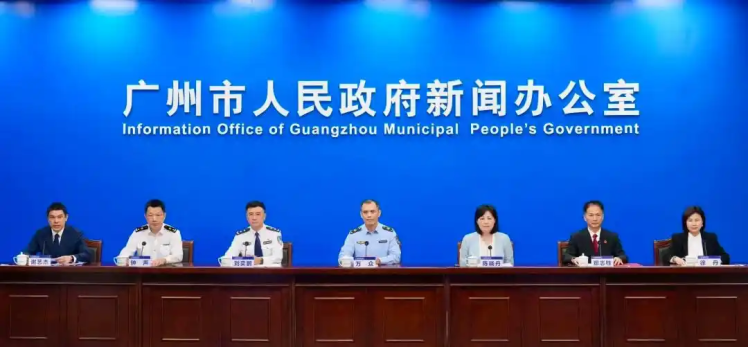
The Sino-Singapore Guangzhou Knowledge City (SSGKC) is the only region in China approved by the State Council to conduct comprehensive reform experiments in the utilization and protection of intellectual property. The year 2026 marks the 10th anniversary of this comprehensive reform. Xu Dan, Deputy District Mayor of Guangzhou's Huangpu District, stated: "Over the past decade, we have firmly grasped the core proposition of 'moving IP from certificates to workshops, and from laboratories into industrial chains,' striving to transform the 'key variable' of IP into the 'largest increment' for industrial development."
Xu Dan noted that the Guangzhou Development District (GDD) and Huangpu District took the lead in establishing China's first district-level intellectual property bureau and rolled out a full-chain policy support system. In 2023, a new round of comprehensive reform was launched, earning the district national-level platform designations, such as a demonstration zone for the high-quality, clustered development of the IP service industry. To date, 40 pioneering measures have been introduced at the national and provincial levels. Intellectual property has firmly become the "hard support" for innovative development and the "golden calling card" for the business environment in the district.
Specifically, these achievements are highlighted in three main areas:
First, tackling "chokepoint" technologies to transform technical patents into industrial dividends. Focusing on strategic emerging industries such as artificial intelligence and integrated circuits, GDD and Huangpu District have established 112 key enterprise service stations and IP protection hubs. This directly supported XPENG Motors in achieving mass production of its in-house developed Turing AI chip. Furthermore, the district built 40 high-value patent cultivation and layout centers, generating over 1,000 invention patents in their first year and driving an additional 1.8 billion RMB in sales of patented products. By 2025, the number of invention patents per 10,000 people reached 409.3, nearly a five-fold increase from 2016. The district has cumulatively won 280 China Patent Awards, including 10 Gold Awards.
Second, resolving "commercialization bottlenecks" to transform dormant IP into active assets. The district pioneered the creation of a "Patent Commercialization and Utilization Manager" team and launched the "Huangpu IP Transformation Camp" brand. It has supported the Guangzhou National Laboratory and China Southern Power Grid in building national-level industrial IP operation centers. By constructing a full-lifecycle financial service chain, the district issued China's first IP securitization product for the new energy vehicle sector. Five such products have cumulatively raised 1.14 billion RMB. During the 14th Five-Year Plan period, IP pledge financing reached 55.37 billion RMB, eight times the amount recorded during the 13th Five-Year Plan period.
Third, building a "comprehensive ecosystem" to elevate property rights protection into the deep integration of industries. Leveraging the aggregation of national, provincial, and municipal IP protection resources, the district established China's first benchmark zone for IP rule of law, creating a protection ecosystem that promotes industrial integration. It pioneered overseas IP infringement liability insurance, with total coverage exceeding 1 billion RMB. The district also issues 10 million RMB in "IP Service Vouchers" annually. The Greater Bay Area Copyright Trading Center now serves over 6,000 enterprises, drawing nearly 500 service institutions to the area. Backed by these comprehensive reforms, the district has cultivated nearly 3,000 high-tech enterprises and 93 listed companies, keeping its technological innovation capability ranked first among national economic development zones for five consecutive years.
Xu Dan concluded that, standing at the new starting point of the 15th Five-Year Plan, the district will continue to deepen reforms, focus on enhancing the level of patent industrialization, and clear the critical bottlenecks in IP transformation and utilization. These efforts will contribute more "Huangpu Experience" to the construction of Guangzhou's modern industrial system and the nation's comprehensive IP reform agenda.


Links
>
Copyright © Guangzhou Development District People's Government.
All rights reserved. Presented by CRI Online
粤ICP备16087157号-1
All rights reserved. Presented by CRI Online
粤ICP备16087157号-1