

Foreign Capital Pursues "Green" Opportunities: Guangzhou Development District Builds a Proving Ground for Green Transformation
Updated : 2026-03-13Recently, Veolia, a Fortune Global 500 company from France, signed an agreement in the Guangzhou Development District to launch a zero-carbon project for industrial flue gas capture and resource utilization. The project is expected to reduce carbon emissions by approximately 200,000 tons annually. Guided by China’s "dual-carbon" goals, the Guangzhou Development District is witnessing accelerated investment from foreign enterprises in green and low-carbon industries.
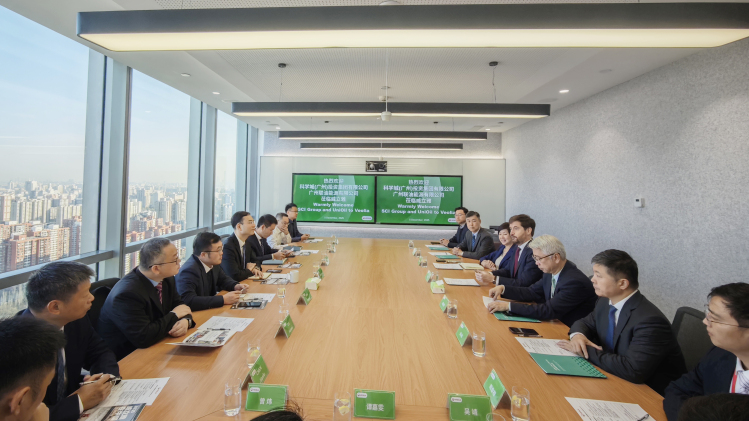
Veolia signs a cooperation agreement with Science City Group
The newly signed zero-carbon project between the Guangzhou Development District and Veolia will support the "Lianyou Phase III" project, currently under construction by Guangzhou Lianyou Energy Co., Ltd., a key enterprise in the district. The Lianyou facility primarily produces carbon black used in tire manufacturing. Once completed, the Veolia project will further extend the regional industrial chain while meeting the demand for thermal energy in surrounding areas.
As a key raw material in tire manufacturing, the production of carbon black generates large amounts of industrial flue gas and waste heat. In the past, treating these by-products required significant investment, leaving enterprises burdened with high pollution-control costs while grappling with energy waste and carbon-emission pressures.
Once the new project is operational, this situation will be completely transformed. An independent carbon-capture facility will be built within the Lianyou plant to recover the waste heat and exhaust gases generated during production. Through an advanced waste-heat recovery system, the thermal energy in the industrial flue gas will be converted into steam and electricity. This will be supplied directly to local enterprises within the industrial park, forming an integrated model of "pollution control and energy recovery."
According to estimates, the electricity procurement cost for the Lianyou Phase III project could be 10% to 30% lower than grid prices, while simultaneously reducing carbon dioxide emissions by about 200,000 tons per year. In industrial manufacturing, the massive energy that was once wasted is now being "captured" and transformed into high-value recyclable resources. Environmental protection is shifting from a cost on the balance sheet to tangible gains on the production line, delivering real reductions in costs and improvements in efficiency. (Text by Fan Minling)


Links
>
Copyright © Guangzhou Development District People's Government.
All rights reserved. Presented by CRI Online
粤ICP备16087157号-1
All rights reserved. Presented by CRI Online
粤ICP备16087157号-1