

Building an "AI City": Guangzhou Huangpu Releases Action Plan to Empower All Industries with Artificial Intelligence
Updated : 2026-03-05Recently, the Guangzhou Development District and Huangpu District released the Action Plan for Empowering All Industries with Artificial Intelligence (hereinafter referred to as the "Action Plan"). The plan clearly states that by 2030, the district aims to achieve an AI industry scale of 100 billion yuan, fully establishing itself as a nationally influential demonstration zone for "AI + New Industrialization" and entering a new stage of intelligent economic and social development.
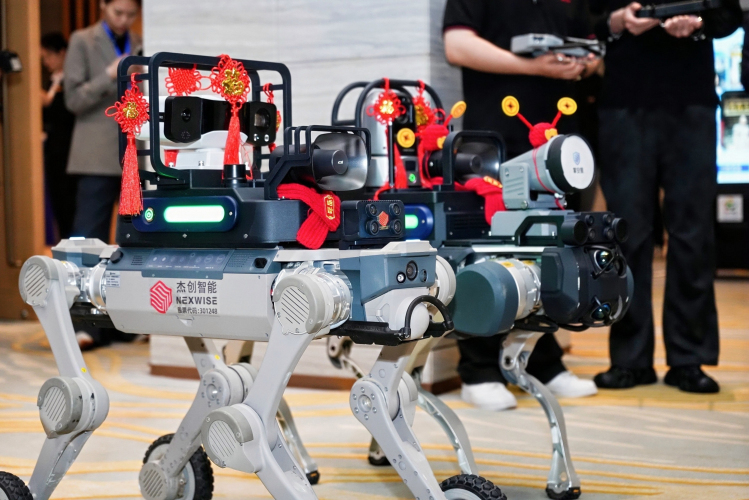
A Jiechuang Intelligent AI robotic dog
In the field of advanced manufacturing, the Action Plan proposes promoting AI applications in areas such as smart construction, high-end equipment, advanced materials, and new energy. Focusing on advantageous industries like automobiles, new displays, intelligent equipment, electronic information, and fashion consumer goods, the goal is to cultivate over 100 vertical large models integrated with industry datasets, develop more than 1,000 lightweight AI products and services, and facilitate the digital transformation of no fewer than 200 small and medium-sized enterprises to Level 2 or above.
In the field of smart energy, aligned with China’s "dual carbon" goals, the plan seeks to build a power intelligence foundation within the national AI industrial system. It includes establishing a pilot innovation platform for AI in the power sector, launching scenario-based validation projects, and promoting embodied intelligence and scientific intelligence in applications such as renewable energy forecasting, intelligent power dispatching, and virtual power plant operations.
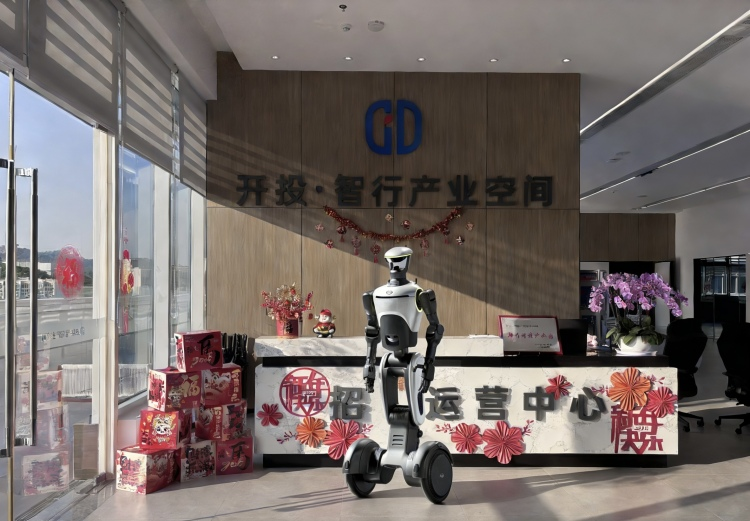
A GAC Group robot settles in the Guangzhou Development District Zhixing Industrial Park
In the service economy, the plan focuses on enhancing the intelligence of commercial consumption, financial services, technological innovation, digital culture and tourism, and related intellectual property. It proposes implementing an "E-commerce Intelligence Upgrade Program," encouraging major commercial districts to introduce immersive consumption experiences, and building an integrated digital ecosystem connecting culture, commerce, tourism, and sports both online and offline. Financial institutions are encouraged to leverage AI models to improve risk control and service efficiency, while private enterprises are supported in leading key technological breakthroughs, using AI to drive a transformation in research paradigms.
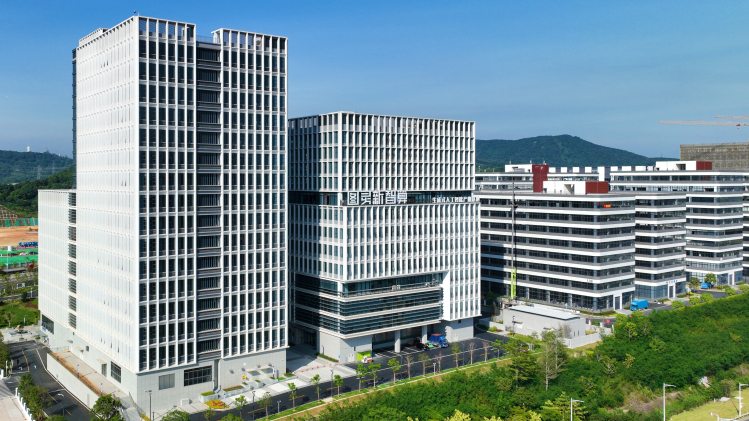
Turing New Manufacturing Generative AI Industrial Base
Photo by Li Jianfeng
Furthermore, the Action Plan outlines initiatives to integrate AI into urban space management, legal governance, public services, administrative efficiency, and public safety, promoting the deep embedding of AI across all dimensions of city development.
In the emerging low-altitude economy, leading companies such as EHang and XPENG AEROHT will spearhead the expansion of innovative scenarios, including urban air mobility and low-altitude logistics. In the field of autonomous driving, the district will continue to advance the "Vehicle-Road-Cloud Integration" system, exploring the large-scale application of unmanned transport equipment in freight logistics. (Text by Huang Sanxiao)





Links
>
Copyright © Guangzhou Development District People's Government.
All rights reserved. Presented by CRI Online
粤ICP备16087157号-1
All rights reserved. Presented by CRI Online
粤ICP备16087157号-1