

Huangpu District Mayor Kicks Off Conference Wearing AI Glasses! How Deep is Huangpu’s Full Embrace of AI?
Updated : 2026-03-02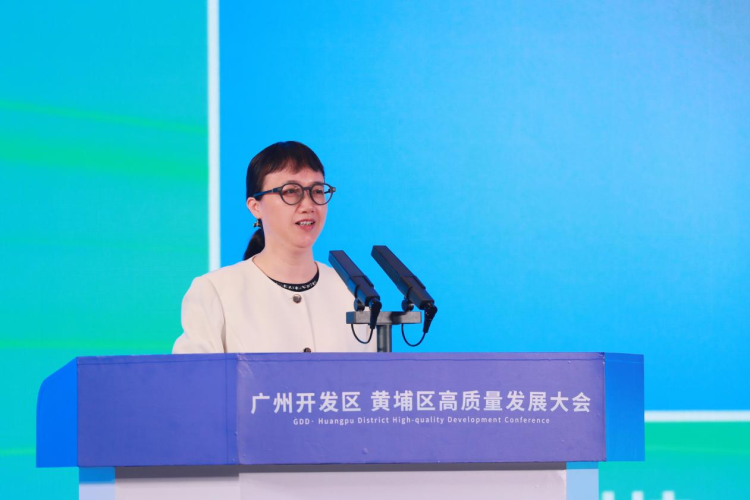
Xian Yinsong, Deputy Secretary of the Party Working Committee of Guangzhou Development District and Huangpu District Committee, and Mayor of Huangpu District, wears smart glasses to endorse Huangpu’s tech products
Photo by Li Jianfeng
In the Year of the Horse, technology unsurprisingly took "center stage" once again at the first major new year conference held by the Guangzhou Development District and Huangpu District. What went viral this time was a futuristic opening. "Today, I specifically put on these smart glasses, which weigh only 35 grams." In her speech, Xian Yinsong, Mayor of Guangzhou’s Huangpu District, showed off this tech item to the entire audience. Hailed as a new form of the "next-generation mobile smart terminal," these are the world’s first smart glasses designed for all-day wear.
With camera flashes popping in the audience, the mayor got straight to the point: "Behind these small glasses lies a massive industry. More than 50 core components connect over 30 manufacturers and service providers." This is a vivid microcosm of the integration of manufacturing and services driven by artificial intelligence.
To drastically slash smart manufacturing costs for enterprises, the district has proactively deployed the Huangpu No. 1 intelligent computing cluster. Moreover, all four computing power projects newly approved by the National Development and Reform Commission for the city have landed in Huangpu. In the future, its intelligent computing power will exceed 50,000 Petaflops, enough to simultaneously meet the computing demands of over 40 million new energy vehicles operating on roads nationwide.
Ample computing power empowers algorithms. The Greater Bay Area headquarters of MINIMAX, China’s first publicly traded large-model AI company, has settled here, and 54 vertical large models have been cultivated. Furthermore, China Southern Power Grid’s Da Watt and GRG Banking’s Wangdao are becoming the smart hubs for vertical industries.
Pursuing self-reliance in microchips is another priority. In January this year, CanSemi, which has been rooted in Huangpu for seven years, launched its Phase IV project with a total investment of 25.2 billion yuan, aiming to build a 12-inch wafer production line with a monthly capacity of 40,000 wafers. Meanwhile, XPeng Motors’ self-developed Turing AI chip has achieved a computing breakthrough—delivering the performance of three chips in one using a 7-nanometer process. In the future, more high-end chips will bear the "Made in Huangpu" mark.
With comprehensive hardware facilities in place, supportive policies are closely following up to provide a safety net. "We promise to go all out to help everyone secure computing power," Xian Yinsong stated emphatically. Huangpu will also issue 30 million yuan in targeted computing, model, and data vouchers to accelerate the cultivation of 100 vertical large models and create 1,000 lightweight AI products and services, ensuring that enterprises no longer worry about computing costs.
Since the beginning of 2026, the Guangzhou Development District and Huangpu District have seen a significant surge in investment promotion, capacity expansion, and financing. In the first two months of the year alone, the district signed 58 projects. At provincial and municipal conferences, three projects—each with investments and output values exceeding 10 billion yuan—were unveiled. Projects involving Tianjie New Energy batteries, high-end PCB circuit boards, and AI integrated circuit substrates are all inextricably linked to AI.
By backing their decisions with real capital, enterprises are casting a clear vote of confidence: investing in AI and Huangpu is an investment in the future.
Guangzhou Development District and Huangpu District rank as the sixth-largest industrial districts nationwide, accounting for 40% of the city’s industrial output value from designated-size enterprises. Supported by a solid foundation of 33 major industrial categories, 133 medium categories, 295 sub-categories, over 1,300 designated-size industrial enterprises, and an annual output value exceeding 800 billion yuan, these districts generate massive amounts of industrial data every day, driving the most genuine and urgent demand for intelligent transformation.
Tearing down the "workshop walls," letting data flow freely, and allowing algorithms to make decisions has become the optimal solution for enterprises in the Guangzhou Development District and Huangpu District to reduce overall operating costs and enhance core competitiveness.





Links
>
Copyright © Guangzhou Development District People's Government.
All rights reserved. Presented by CRI Online
粤ICP备16087157号-1
All rights reserved. Presented by CRI Online
粤ICP备16087157号-1