

CRI Online: Guangzhou’s Huangpu District Builds a Full-Chain “Ecosystem Runway” for the Low-Altitude Economy
Updated : 2026-01-13Early in the morning, an autonomous passenger-carrying aircraft lifts off smoothly from the Suigang Wharf in Huangpu, Guangzhou, gliding toward the skies above the Pearl River estuary. At the same time, screens at the ground command center display the real-time integration and dynamic generation of flight routes, airspace, and meteorological data. This is not a science fiction scene, but a vivid snapshot of the daily operation of the low-altitude economy in Guangzhou Development District and Huangpu District—one that feels distinctly futuristic.
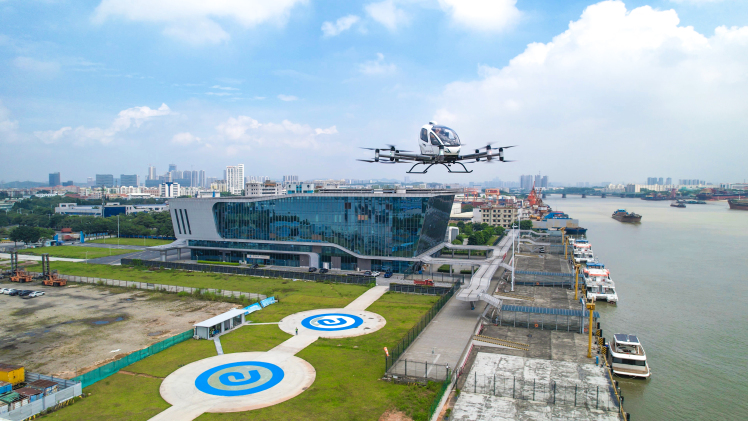
EHang Future City Suigang Wharf Flight Base
As a pioneering force in this emerging sector for Guangzhou and Guangdong Province, Guangzhou Development District and Huangpu District are building a complete industrial chain covering the entire low-altitude economy. Focusing on key areas such as complete aircraft R&D, communications and navigation, airspace management, and infrastructure, the district has attracted over 50 core enterprises from across the industry chain. From the commercial operation of autonomous passenger-carrying aircraft developed by EHang, to Chengxing Communications strengthening the radio-frequency foundation for integrated air–space–ground networks; from Tunan Technology developing an intelligent low-altitude “traffic brain,” to state-owned enterprises in Huangpu establishing industrial platforms and flight-test facilities—a comprehensive effort to leverage a supportive ecosystem for the industry to achieve a leading takeoff is now fully underway.
Currently, Guangzhou Development District and Huangpu District have attracted more than 50 key enterprises across the low-altitude economy value chain, with an industrial scale valued at approximately 13.4 billion yuan, making the area one of the most important low-altitude economy clusters in China. The district is home to 13 national-level “Little Giant” specialized and innovative enterprises, three single-product champion enterprises, and nine listed companies, covering the full industrial chain from R&D and raw materials, through midstream component manufacturing and integration, to downstream applications and services. EHang has launched regular passenger-carrying trial operations in the district, the world’s first large-scale mass-production flying car factory has entered trial production, and industry leader XAG has relocated to the area, with cluster effects continuing to intensify.
Application scenarios have also expanded across the board. Huangpu District has launched the country’s first low-altitude intelligent customs clearance delivery route within a comprehensive bonded zone, improving logistics efficiency by 50 percent. Drone delivery of urban medical supplies has achieved a 65 percent increase in efficiency. Passenger-carrying aircraft flight experiences have been conducted at multiple sites, exploring the integration of “low-altitude plus cultural tourism.” In the first half of 2025 alone, various low-altitude flight activities in the district exceeded 10,000 sorties.
Through top-level planning, spatial support, industrial funds, and the opening of application scenarios, Huangpu has built what officials describe as the most suitable “ecosystem runway” for the low-altitude economy to take off. According to officials, Guangzhou Development District and Huangpu District have designated the low-altitude economy as a key future industry and formulated a clear development roadmap: a foundation-building phase from 2024 to 2026, rapid growth from 2027 to 2030, and full-scale development from 2031 to 2035. On the policy front, the district has established a “1+N” policy framework and introduced Guangdong Province’s first district-level planning for air routes and takeoff and landing sites, forming a “3+9+N” takeoff and landing system. Its unprecedented “11 Policies for the Low-Altitude Economy and Aerospace” offer enterprise incentives of up to 30 million yuan, sending a strong signal of industrial attraction. (By Xu Wan)





Links
>
Copyright © Guangzhou Development District People's Government.
All rights reserved. Presented by CRI Online
粤ICP备16087157号-1
All rights reserved. Presented by CRI Online
粤ICP备16087157号-1