

The 4th Belt and Road International Industrial Cooperation Forum Held in Huangpu District, Guangzhou
Updated : 2025-12-12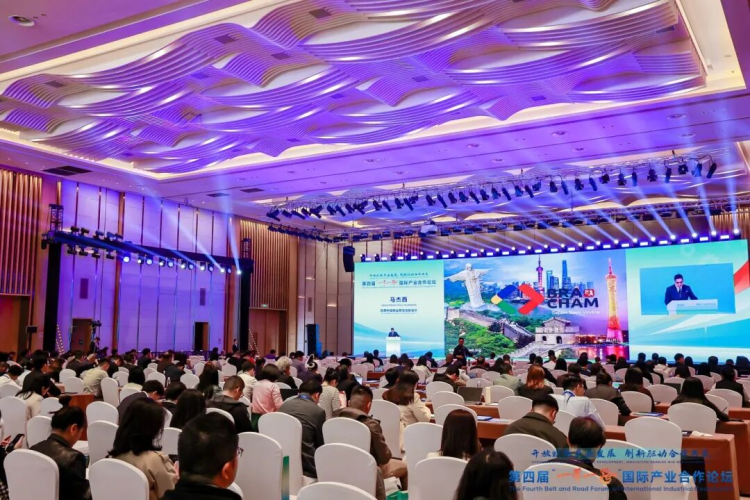
Scene of the 4th Belt and Road International Industrial Cooperation Forum
On December 10, the 4th Belt and Road International Industrial Cooperation Forum was held in Huangpu District, Guangzhou. Nearly 500 representatives from business associations, enterprises, institutions, and academia from China and Belt and Road partner countries—including Vietnam, Brazil, Thailand, Jordan, the United Arab Emirates, and Saudi Arabia—gathered to discuss new opportunities for industrial cooperation. The forum comprehensively showcased Guangzhou Development District’s dynamic practices in advancing high-level openness and innovation and served as an important platform for deepening industrial cooperation under the Belt and Road Initiative.
As the host location, Guangzhou Development District and Huangpu District demonstrated their prominent advantages as a core hub and high-level opening center within the Guangdong–Hong Kong–Macao Greater Bay Area.
“The Belt and Road Initiative provides an important opportunity for the global layout of advanced manufacturing,” said Zhang Hong, Vice President of EHang Holdings Limited. He noted that the company is promoting the global deployment of advanced aircraft manufacturing and related standards. He further pointed out that China has established an independently developed airworthiness standards system in the field of Advanced Air Mobility (AAM) and is actively engaging in international cooperation.
For example, in a smart city air mobility project in Thailand, the Director General of the Civil Aviation Authority of Thailand personally experienced a demonstration flight. It is planned that by the end of 2026, large-scale commercial operations of the EH216-S unmanned eVTOL will be realized in more than 20 sandbox zones across Thailand, with a total of 100 aircraft. This marks the expansion of China’s intelligent manufacturing from products going global to standards going global.
Victor Wei, Director of the Brazil–China Business Council, stated that the Council is actively facilitating resource connections between Brazilian enterprises and China, particularly the Guangdong–Hong Kong–Macao Greater Bay Area, to promote deeper China–Brazil cooperation. Pan Thi Tra Mi, President of the China–Vietnam Chamber of Commerce, also said that the Chamber is closely monitoring Guangzhou—especially Huangpu District—for its industrial cluster advantages in intelligent manufacturing, biomedicine, and other sectors. Based on market demand in Vietnam, the Chamber will organize targeted business matchmaking between Chinese and Vietnamese enterprises to accelerate project implementation.
To date, Guangzhou Development District and Huangpu District have attracted more than 5,200 foreign-invested enterprises and are home to 330 projects invested by Fortune Global 500 companies. Its business environment evaluation has ranked first among national economic and technological development zones in China for five consecutive years. Currently, Guangzhou Development District is accelerating the development of its “Three Cities and One Island” strategic platform, centered on Sino-Singapore Guangzhou Knowledge City, Guangzhou Science City, Guangzhou Maritime Silk Road City, and Guangzhou International Bio-Island. It has also established an international cooperation network spanning 38 countries and regions worldwide.
During the forum, participants conducted on-site visits to Guangzhou Development District, gaining firsthand insight into its innovative vitality and development achievements as a key node in the global industrial chain, further underscoring Huangpu District’s pivotal role in advancing practical cooperation under the Belt and Road Initiative.


Links
>
Copyright © Guangzhou Development District People's Government.
All rights reserved. Presented by CRI Online
粤ICP备16087157号-1
All rights reserved. Presented by CRI Online
粤ICP备16087157号-1